The Plan is a Single Lever
In 20th-century Western leisure, gaming machines were designed around friction, adrenaline, and scarcity. The pinball table and slot machine demanded constant physical agitation—a frantic struggle where the participant fought against loss to achieve individual triumph.
The One-Armed Utopia: The Plan is a Single Lever departures from this logic to stage the ease of cybernetic state settlement. Under automated planning, resistance is not merely futile; it is made obsolete by algorithmic comfort. The participant is provided only a single mechanical lever. Through this solitary, effortless touchpoint, the player does not fight the machine; they participate in a pre-harmonized trajectory where victory is already guaranteed by the central system.
The Panoptic Peepshow Dynamic: The installation establishes a sharp spatial tension between the solitary player and the museum audience. The participant stands alone, their eye pressed into a machined brass periscope viewing a private virtual simulation. Meanwhile, the surrounding gallery space is filled with the crystalline acoustic ringing of an unamplified slip-cast porcelain plate physically struck by an electromagnetic solenoid upon every predetermined collision.
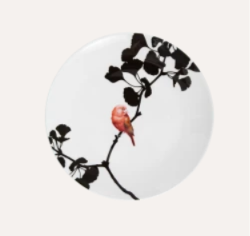
Slip-cast bone-porcelain disc with black sumi-ink ginkgo branch and cinnabar red bird. The aesthetic emblem of the solitary lever.
Collisions within the participant's monocular periscope trigger a physical 12V solenoid, striking the single suspended Meißen porcelain plate hanging pristinely from the gallery ceiling.
The Solitary Suspended Meißen Porcelain Resonator
In the gallery volume, only one single slip-cast porcelain plate hangs suspended from the high ceiling on a fine vertical aircraft steel wire. Positioned at the plate's upper perimeter is a single 12V electromagnetic push-pull solenoid striker. When the red ball in the private periscope hits an obstacle, the solenoid strikes this solitary bell in real-time, sending an unamplified, crystalline ring across the quiet exhibition room.
Gallery Spatial Installation & Architectural Perspective
The 3D architectural perspective below illustrates the spatial tension of the installation in the museum gallery: the solitary participant stands/leans into the machined brass Fernglas plinth (wearing spatial audio headphones), while exactly one single unamplified porcelain plate hangs suspended from the high ceiling as a solitary mechanical bell in the volumetric space.
Dresden Cybernetics (Robotron) × Meissen Porcelain
The installation is anchored in the media archaeology of Saxony and Central Europe. Dresden was the computational heart of the GDR (home to Kombinat Robotron, which engineered mainframes to calculate state five-year economic plans). Meanwhile, the adjacent Elbe valley (Meißen) is the historic birthplace of European white porcelain—a material that began as a secret imperial state monopoly.
Yao Wang’s ceramic practice at the Kunstuniversität Linz bridges this historical tension: employing raw slip-cast porcelain not as decorative craft, but as acoustic physical resonators. The fragile ceramic discs act as the sounding board for digital state collisions, generating an unamplified clockwork acoustic environment that reverberates through the museum.
Hardware Technical Rider
- 1. Monocular Optical Periscope Machined brass tube housing a 1.39" high-DPI micro-OLED circular display (454×454 px) and optical glass loupe.
- 2. Solitary Recoil Flipper Industrial spring-loaded arcade lever fitted with a 12V recoil solenoid for tactile mechanical kick on actuation.
- 3. Cybernetic Edge Compute Engine Raspberry Pi 4 running an offline 2D rigid-body Box2D physics loop, driving micro-OLED output and GPIO triggers in <2 ms.
- 4. Suspended Acoustic Ceramic Resonator Single 28cm slip-cast Meißen bone-porcelain plate suspended on aircraft steel wire, struck in real-time by a 12V push-pull solenoid striker via RS-485 relay.
Ben
Hardware engineer and media artist based in Dresden, Germany. Recipient of the 2026 CME production grant for kinetic optical tracking systems. Specializes in 3-DoF optical kinematics, precision CAD fabrication, embedded micro-controllers (Raspberry Pi/Pico), and sovereign edge computing.
Yao Wang
Visual artist based in Linz, Austria. Master’s student in Plastische Konzeptionen / Keramik at the Kunstuniversität Linz. Following his B.A. in Graphic Design in St. Petersburg and a 4-year artistic practice in Belgrade, his work explores cultural identity, socio-political structures, and material tensions between ceramics, sculpture, text, and moving images.
2-Month Residency Production Schedule & Budget
| Phase | Timeline | Deliverables & Milestones |
|---|---|---|
| Phase 1: Ceramics & Optics | Month 1 (Weeks 1–4) | Slip-casting and acoustic pitch tuning of porcelain plates at host ceramic lab; machining the brass telescope tube and optical lens mount; console cabinet fabrication. |
| Phase 2: Kinetics & Integration | Month 2 (Weeks 5–8) | Wiring the 8-channel solenoid matrix; integrating Box2D physics simulation with haptic flipper recoil; full acoustic resonance balancing in exhibition space. |
Host Institution Preference
1. WRO Art Center (Wrocław, Poland) — Primary Match (Central European media archaeology & kinetic lineages)